
July 30, 2026
Oslo, Norway – 30 July 2026 – RESPINOR AS, a Norwegian MedTech company pioneering non-invasive diaphragm monitoring technology, today announced that it has submitted a De Novo Classification Request to the U.S. Food and Drug Administration (FDA), seeking marketing authorization for RESPINOR DXT®.
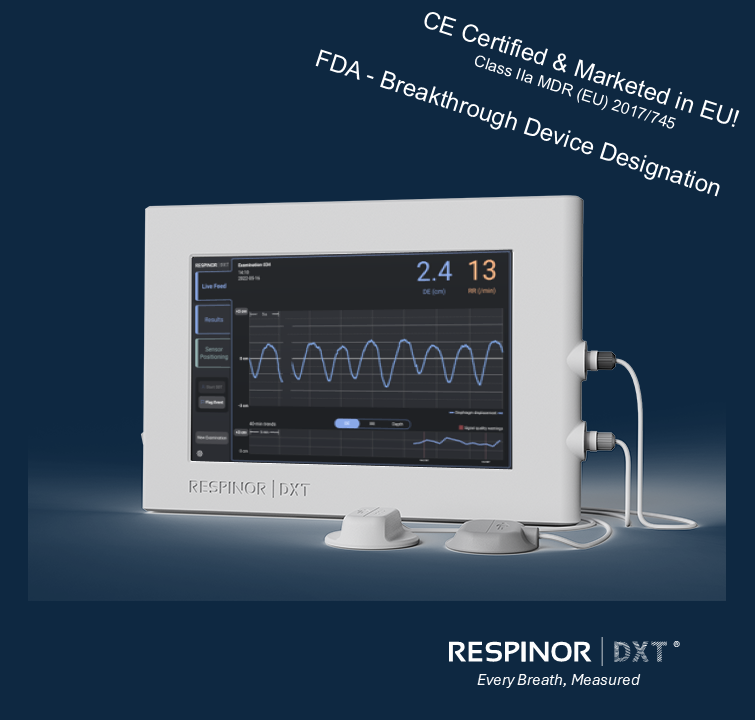
The submission marks a major milestone in RESPINOR’s mission to make diaphragm monitoring more accessible at the bedside for critically ill patients. RESPINOR DXT has previously received FDA Breakthrough Device Designation and is CE marked and commercially available in Europe.
Weaning from mechanical ventilation is a high-risk process that has traditionally relied on intermittent, operator-dependent assessments of diaphragm function. Diaphragm dysfunction is a well-documented complication in mechanically ventilated adult ICU patients and is associated with prolonged ventilation, weaning failure, longer ICU and hospital stays, and increased mortality.
RESPINOR DXT has been evaluated in clinical studies involving nearly 400 patients.
An early feasibility study validated the technology against conventional ultrasound and identified a diaphragm-excursion threshold of 1.1 cm for predicting weaning outcome. The findings were published in Critical Care in 20241.
The threshold was subsequently evaluated in two blinded, prospective, multicenter studies conducted at eight hospitals in France and Norway. Patients with diaphragm excursion below 1.1 cm had an eightfold higher risk of reintubation and spent, on average, two additional days in the ICU and five additional days in the hospital compared with patients above the threshold2.
RESPINOR DXT is an ultrasound-based technology designed to provide operator-independent, continuous, real-time insight into diaphragm function, helping clinicians identify patients with low diaphragm excursion who may be at increased risk of extubation failure and supporting more informed extubation and ventilation decisions, for optimal patient care.
“Submitting our De Novo request is a major milestone for RESPINOR and an important step toward making reliable diaphragm monitoring available to critical care teams in the United States,”
“Our clinical program demonstrates the potential importance of identifying patients with low diaphragm excursion before extubation. I am incredibly proud of the team that brought us to this point and grateful to the clinicians and patients who contributed to our clinical studies. We look forward to working with the FDA throughout the review process.”
said Trude Tingvoll, CEO of RESPINOR.
“Diaphragm dysfunction is an important yet often under-recognized challenge in mechanically ventilated patients. Improved access to objective and standardized bedside monitoring of diaphragm function could provide clinicians with valuable information during the management and weaning of critically ill patients. The FDA submission of RESPINOR DXT represents an important milestone toward making this technology available to clinicians and patients in the United States”,
said Prof Alexandre DEMOULE, Head of the Medical Intensive Care Unit and Weaning Centre - Respiratory Division at Hôpital Universitaire Pitié - Salpêtrière, Paris, France.
RESPINOR DXT has not received FDA marketing authorization and is not commercially available in the United States.
RESPINOR AS is a Norwegian MedTech company headquartered in Oslo, dedicated to transforming intensive care through non-invasive, continuous monitoring of the diaphragm, the primary muscle of respiration. The company has developed RESPINOR DXT®, a novel ultrasound-based platform technology designed to provide real-time insight into diaphragm movement in mechanically ventilated patients. RESPINOR DXT® is CE marked under the EU Medical Device Regulation and is intended to support clinical decision-making during the weaning process from mechanical ventilation. RESPINOR DXT has received FDA Breakthrough Device Designation. RESPINOR is a privately held company.
Contact information:
Trude Tingvoll, CEO
Email: t.tingvoll@respinor.com
Phone: +47 474 53 313
References
-
Product • Newsroom • Team • Board of Directors • Investors • About • Contact • Privacy Policy •

RESPINOR: MedTech innovator specializing in diaphragm monitoring, introducing DXT, a non-invasive ultrasound-based technology to improve critical care and outcomes.
RESPINOR AS
Address: Gaustadalleen 21, 0349 Oslo, Norway
Phone: +47 24 02 25 54
Mail: mail@respinor.com
Monday-Friday: 8:30 to 17:00